It’s intriguing how news stories can bubble under the surface for a while and then explode into the public eye, with significant consequences for everyone involved.
Today’s example is the case of the Renew London waste recycling bins, which have been appearing on City of London streets since January 2012. As well as being a regular waste bin they are equipped with a large screen on each side for displaying digital advertising.
Up until recently that’s all we thought they did, until an article in Quartz magazine brought a darker side to the public attention.
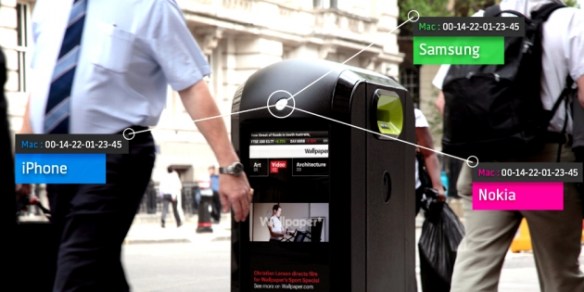
Up to a dozen of these smart bins have been secretly scanning for passing mobile devices and storing this data to compile a database of the movement of individuals around the City of London. All of this was done without consent, although the trial details have been published on the Renew London web site.
How do they do this you might be wondering? Every device capable of using Wi-Fi has a permanent hardware (MAC) address which uniquely identifies the device and often even the make and model. If your mobile device has Wi-Fi enabled then your unique MAC address is broadcast periodically when your device scans for access points.
The Renew London smart bins can listen out for these signals and record the MAC addresses that it ‘sees’. According to the published trial data they captured nearly a million devices on just one day in June!
They would probably still been doing this if it wasn’t for the sensationalist claims from the Renew London CEO Kaveh Memari, who went a little too far in explaining just what his technology is capable of.
Memari said he was working on a proposal for a bar that would install five tracking devices: one by the entrance, one on the roof, one near the cash register, and one in each of the bathrooms. That would allow the bar to know each person’s gender (from the bathroom trackers), how long they stay (“dwell time” is the official metric), and what they were there for (a drink outside or a meal inside). And targeted advertising for the pub could follow those people around London on Renew’s omniscient recycling bins.
It would seem that the City of London Corporation was not aware of exactly what Renew London had been up to and the adverse publicity has caused them to swiftly deal with the situation.
THE collection of data from phones and devices carried by people passing sophisticated waste bins in Square Mile streets should stop immediately, says the elected City of London Corporation, which provides local authority services to the global business district around St Paul’s.
A spokesman said (Monday): ‘We have already asked the firm concerned to stop this data collection immediately and we have also taken the issue to the Information Commissioner’s Office. Irrespective of what’s technically possible, anything that happens like this on the streets needs to be done carefully, with the backing of an informed public.’
The bombproof waste and recycling bins, which also carry TV screens with public information, were installed as a way of re-introducing waste bins to City streets.
‘This latest development was precipitate and clearly needs much more thought – in the meantime data collection – even if it is anonymised – needs to stop,’ added the spokesman.
An official statement from Mr Memari has also confirmed a cessation of the ‘trial’:
During our initial trials, which we are no longer conducting, a limited number of pods had been testing and collecting annonymised and aggregated MAC addresses from the street and sending one report every three minutes concerning total footfall data from the sites. A lot of what had been extrapolated is capabilities that could be developed and none of which are workable right now. For now, we no longer continue to count devices and are able to distinguish uniques versus repeats. However, the process is very much like a website, you can tell how many hits you have had and how many repeat visitors, but we cannot tell who, or anything personal about any of the visitors on the website. So we couldn’t tell, for example, whether we had seen devices or not as we never gathered any personal details.
Future developments will, however, not just depend on technology, but also, most importantly, on people being comfortable with interactive technology – much as has happened over the course of the weekend on the internet.
This is a somewhat less ebullient statement than one of Memari’s previous quotes:
“The chances are, if we don’t see you on the first, second, or third day, we’ll eventually capture you,” he said. “We just need you to have it on once.”
What can you do to protect yourself from this gross invasion of privacy? Disable Wi-Fi (and Bluetooth) if you aren’t actively using it when you’re out and about. Doing this will help save your battery too. You can also register your MAC address and opt-out of data collection via the Presence Orb web site.
It’s interesting to note that since this story broke the Renew London bin screens have been conspicuously devoid of any advertising. Evidently advertisers don’t want to be associated with this trial either.
 Update: 12-Feb-2015
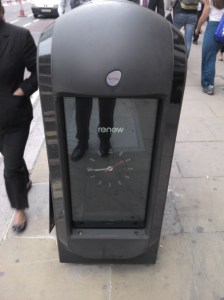
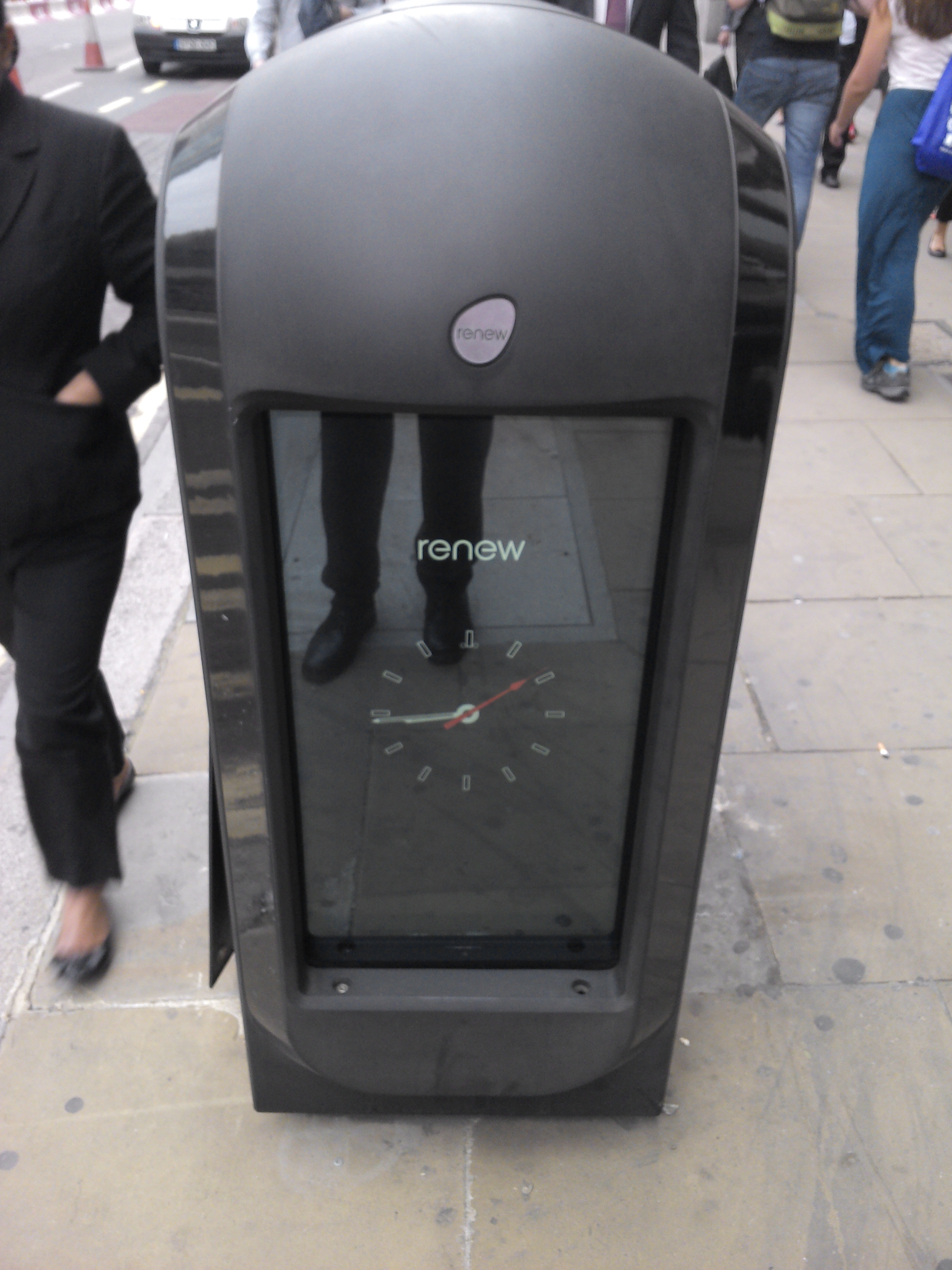
London’s ‘smart’ bins have been unceremoniously decommissioned, as you’ll see in this photo.
The RenewLondon.com domain name was sold in June 2014 and it now resolves to an accounting blog.
The former Renew London business seems to have disappeared without a trace, disproving the theory that where there’s muck there’s brass!


 WebDiary.com