Using NSAPI to identify tethered data connections

During my time working at mobile operators I’ve often been asked if it’s possible to differentiate regular on-device web browsing from tethered data traffic.

Tethering refers to the practice of sharing your mobile phone’s cellular data connection with external devices connected by Bluetooth or a serial cable. For example, you might activate tethering on an iPhone and use your mobile data on a connected laptop.
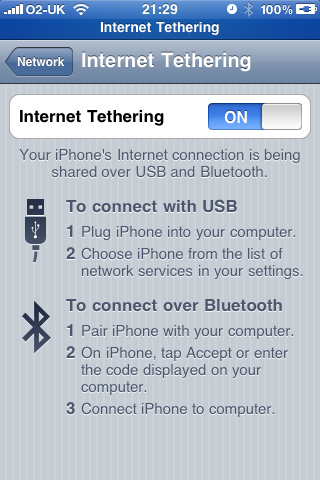
Smartphones generally do a very good job of providing transparent tethered data to connected devices (and hiding these from the network!), so it’s not usually possible for the mobile operator to easily identify tethered traffic.

You could perhaps use deep-packet inspection to search out user-agent headers, but this method is not reliable and not scaleable.

When I first started looking into this problem, I came up with the idea of getting the mobile device to make a clear distinction between on-device and tethered data consumption. The ideal identifier to use for this task is the Network Service Access Point Identifier – or NSAPI.

When an application requests a data bearer, the mobile device sends a PDP context activation request to the radio network.

Contained within the PDP context activation request is the NSAPI value. The NSAPI identifies a PDP context within the mobile device and the SGSN. This is necessary because a device may have multiple PDP contexts and application endpoints.

The mobile device usually allocates NSAPI 5 to the first PDP context. The reason for this is that according to the design specs (3GPP TS 24.008), the first five NSAPI values are reserved.
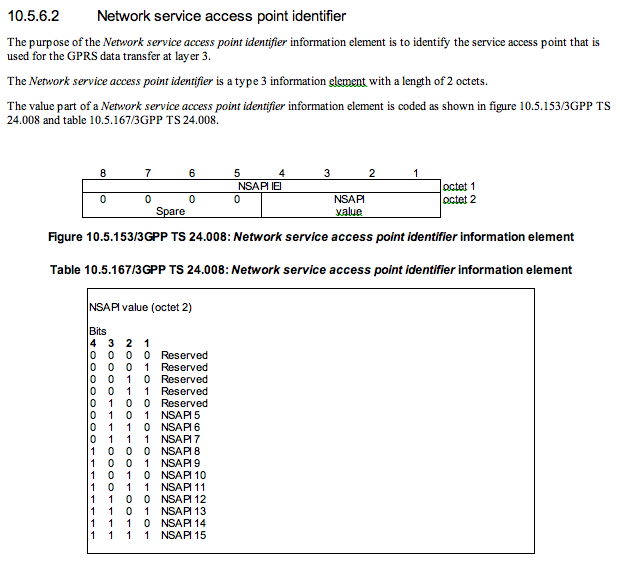
My proposal is to use the previously reserved NSAPI values (0-4) to identify an endpoint that is terminated on an external tethered device.

By using these reserved values the SGSN can distinguish between on-device data and tethered connections. This could be used to apply different network quality of service parameters or even differential billing.

I first proposed this solution in 2002, but it’s going to take widespread industry adoption to make it happen, particularly from the mobile device vendors. But with LTE just around the corner, perhaps this solution is too late?

BT fix Openzone roaming

In July 2008 O2 announced a deal with BT to provide access to over 3,000 BT Openzone premier WiFi hotspots for all their iPhone customers.

There was however a technical spanner in the works, which has prevailed in ruining this bonus ever since. The name of this ‘spanner’ is BT FON.

FON is a network of community hotspots, which in the UK is mostly made up of BT Total Broadband customers. As a BT customer you can opt-in to sharing your broadband bandwidth with other FON members. In return you have access to any BT FON community hotspot that you come across.

It’s actually quite a neat idea, but the launch of this service introduced a big problem for iPhone customers trying to use the BT Openzone premier hotspots.

For reasons best known to themselves, when BT set up a BT FON community hotspot they also make it act like a BT Openzone hotspot. This is fine if you’re a BT FON member as you can roam onto either of these networks, but if you’re a subscriber of BT Openzone through a partner like O2 then you only have access to the BT Openzone premier hotspots.

Most smartphones remember known WiFi networks and will automatically associate with them when they are in range. The only way they have of differentiating between networks is the network name – or SSID.

If you save the “BT Openzone” SSID on your smartphone then it will attempt to use a WiFi hotspot that broadcasts that name whenever it’s in range. This allows the device to seamlessly move between WiFi access points and cellular data without having to ask you each time.

The problem for O2 customers is that when have registered with BT Openzone and saved it as a known network, your smartphone will blindly associate with any hotspot which claims to be “BT Openzone”. This includes the BT FON hotspots for which you don’t have access!

When this happens your smartphone effectively goes offline and apps which rely on a data connection stop working until you move out of range. The only remedy for this is to remove BT Openzone from the known networks list, which is an inconvenience and negates the benefits of a BT Openzone subscription.

Now finally it seems that BT are addressing the problem. They are hastily updating residential home hubs and changing the broadcast SSID from “BT Openzone” to “BT Openzone-H”.

Thank you BT. It’s only taken you 4 years to sort this mess out.

Google Maps API

Google have announced that they will introduce usage limits and start billing excess usage fees for their Google Maps API from 1st January 2012.

The free usage limit has been set at 25,000 map loads per day. If you exceed this limit your choices are:

Excess usage is billed at $4 per 1,000 map loads.

What happens if you do none of these?

Your maps will continue to function. However if your application qualifies for and consistently exceeds the published Maps API usage limits, you do not have a Maps API Premier license, and you do not enroll for online purchasing of excess map loads, a warning may be shown on your map and a Maps API Premier sales manager may contact you to discuss your licensing options.

While this apparently won’t affect 99.65% of users and is aimed squarely at the high-usage ‘abusers’, one does wonder what plans Google have for widening the net of their haul by reducing the limits even further.

Fortunately developers who use the Maps External Library to embed maps in their Android or iOS apps shouldn’t be affected, but again I wonder how long before Google decide to cash-in on this lucrative revenue stream too.

Apple presumably have the same fears. Earlier this year they quietly acquired Swedish mapping technology firm C3 Technologies, so it’s probably safe to assume that they are developing an alternative maps API to challenge Google’s dominance.

While I appreciate that Google is a profit-making commercial enterprise, the manner in which these fees have been introduced is a cause for concern.

It’s akin to a drug dealer giving away free hits and then exploiting the poor addicts once they’re hooked on drugs.

Is this indicative of a new Google business model to get us all using their ‘free’ services and then bleed us dry once we’re all dependent?

Google’s “Don’t be evil” corporate motto might need to be updated soon.

" The first one's free kid ... "

HTC’s Dropbox bonus deception

HTC have been promoting a partnership with Dropbox which gives HTC smartphone customers an additional 3GB of free Dropbox storage space.

The extra storage capacity appears when you activate the Dropbox client on a HTC smartphone with the new HTC Sense 3.5 software.

There’s something they don’t tell you though, which only becomes apparent when you receive the confirmation email from Dropbox:

Congrats on becoming a Dropbox Guru! We’ve awarded you 3GB of bonus space for the next 12 months! You now have 5.25GB on Dropbox. To get even more space, check out our upgrade options.

Thanks again for supercharging your HTC phone with Dropbox!

According to the email, the 3GB bonus space is only awarded for 12 months.

This has been confirmed in the Dropbox support forums by their staffer ‘Michael N’:

We are excited to confirm the announcement from HTC. Owners of HTC phones with a Sense 3.5 ROM will be receiving 3GB of extra space for 1 year, free of charge. All you need do to earn the space is install the Dropbox app on the HTC phone, then complete the Getting Started Quest at www.dropbox.com/gs

So what happens if you are still using the 3GB of bonus space at the end of the 12 months?

Well according to an update from Michael N: “The 3GB extra space goes away, and you’re over quota. Your Dropbox desktop client will stop syncing.

Your options are then to delete files and reduce your storage to under the 2GB free limit or upgrade to Dropbox’s Pro 50 plan at a cost of $9.99/month. How convenient!

While Dropbox themselves have been fairly transparent, HTC have been careful not to mention this built-in timebomb.

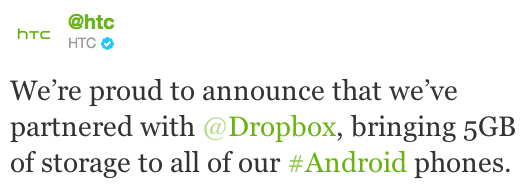
The bonus space is time-limited and only available to owners of a HTC phone with the new Sense 3.5 ROM. This is very different to HTC’s announcement: “We’re proud to announce that we’ve partnered with @Dropbox, bringing 5GB of storage to all of our #Android phones.

The Advertising Standards Authority now regulates advertising across all media -including marketing on websites. I wonder if this includes marketing statements made on Twitter from an official company account?

I feel a complaint to the ASA coming on!

Kindle Tax

I don’t have much spare time to indulge in picking up a book, so when I do have the occasional few minutes what I need is quick and easy access to books on demand.

The 21st century solution to my needs is an eBook reader. It would allow me to keep all my books in one place and I won’t have weighty tomes cluttering up the bookshelves. I suppose there’s also a minuscule environmental benefit too 🙂

I’m sold on the obvious benefits, so what about the cost of the books?

Now call me old fashioned (I dare you!), but I did expect eBooks to cost less than the manufactured print equivalents. So a quick look at the most popular eBook seller – Amazon – had me confused.

Why are the electronic versions sometimes more expensive than their tree-killing counterparts?

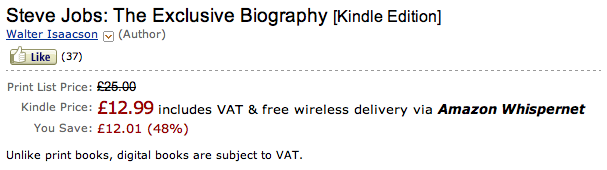
For purchases made within the European Union, this is partly due to the addition of Value Added Tax (VAT).

Conventional print books have historically been treated as an exceptional item and attract a zero rate of VAT in the UK. An eBook however is classified as the “supply of the digitised content of books over the internet or an electronic network” and standard rates of VAT apply.

This is an unexpected reality, but maybe not a showstopper for me. At least I’ll be contributing to the UK economy right?

Unfortunately that’s a false assumption.

Amazon claims to deliver Kindle purchases from Luxembourg and according to the Kindle License Agreement: “The laws of the Grand Duchy of Luxembourg, without regard to principles of conflict of laws, will govern this Agreement and any dispute of any sort that might arise between you and Amazon.

The standard rate of VAT in Luxembourg is 15% and this is the sales tax included in the price of Kindle eBooks.

Every time you purchase a Kindle eBook from Amazon.co.uk you unwittingly contribute 15% of the purchase price to the Luxembourg economy.

I’d better put up some more shelves.