Front Page News?

It’s bewildering what the BBC considers to be front page news.

BBC NEWS TOP STORIES: O2 apologises for roaming glitch
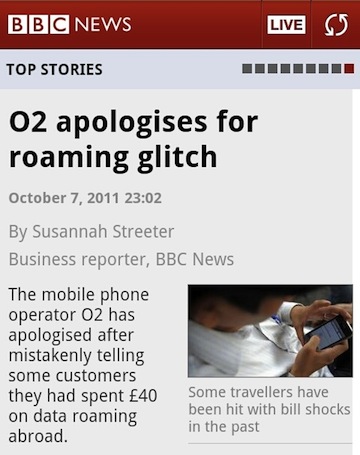
Oh dear! Did international roaming fail leaving O2 customers without data services abroad, or did naughty O2 overcharge their customers? No, neither.

This headline actually relates to an insignificant story of how a very small number of O2’s roaming customers received a text message incorrectly informing them that they had run up large data roaming charges.

Rachel Sinclair, from Bristol, was just hours into her trip to France on the 24 September, when she received a text on her iPhone telling her she had downloaded £20 of data.

“I double checked the roaming function was off and then turned off the handset but the next morning I received another text saying the bill had gone up to £40. I was away with friends and it really took a bit of pleasure out of the holiday.”

After investigating her case, O2 said that she had in fact accrued just 60p in data roaming charges, not £40.

The company estimates that she was one of up to 100 customers who were sent messages in error at the end of last month, warning them they had reached data roaming limits even though they had not downloaded that amount.

So this wasn’t a case of a mobile operator overcharging, just their automatic warning systems being a bit trigger happy.

This text glitch apparently affected “up to 100” of O2’s 22 million mobile customers (0.0005% of O2’s mobile customer base), but still the BBC News editors deemed this story of sufficient international public interest to promote it to their front page.

BBC: Some travellers have been hit with bill shocks in the past

So? Some travellers have been hit by lightning in the past! What has this got to do with anything? It’s sloppy sensationalist journalism, at a time when the National Union of Journalists are complaining about the proposed cuts at the BBC. First for the chop should be Susannah Streeter, the author of this drivel.
Steve Jobs

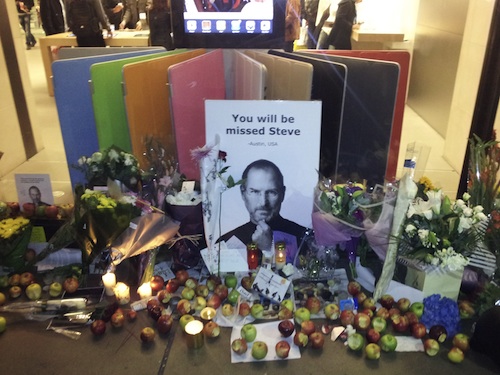
I am feeling quite emotional about the sad passing of Steve Jobs. I have previously been closely involved in the technical development of iPhone and so perhaps feel a more personal connection that extends beyond being an Apple fanboi.

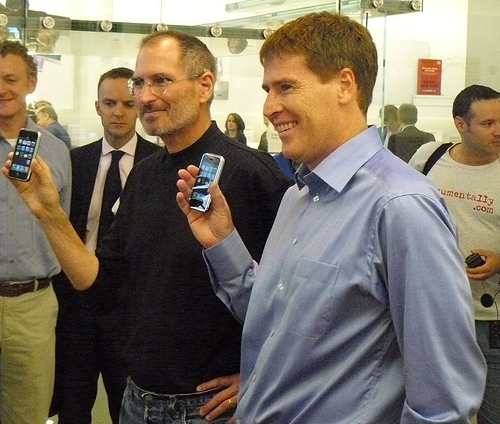
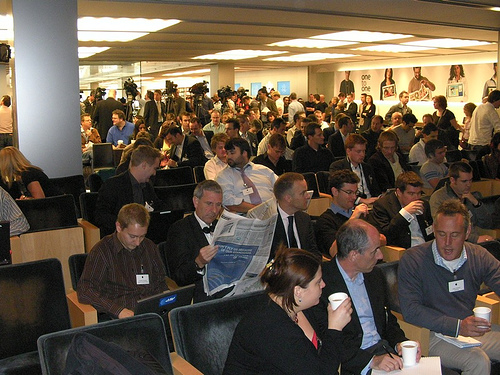
The closest I came to meeting the great man in person was at the ‘Mum is no longer the word‘ Apple press conference at the Regent Street store in London on 18th September 2007. I’m lurking in the crowd somewhere in the auditorium below!

I’ll never forget the buzz of anticipation from the assembled hacks as Steve Jobs took to the stage to announce the exclusive partnership between Apple and O2 (to sell the original iPhone). This was the worst kept secret in the industry, but the excitement of Jobs coming to town to personally reveal the deal was palpable.

I read the news of Jobs’ death this morning while checking the BBC News app on my touch-screen mobile phone. This is the type of information snacking that most smart phone users do habitually and now take totally for granted.

The way we interact with mobile devices and consume mobile data has changed beyond all recognition since the original Apple iPhone launched in 2007.

Jobs’ obsessive attention to detail in all aspects of Apple’s product development has made complicated technology accessible to all. iPhones, iPods and iPads have become ubiquitous, not just because of their technical capabilities but because they are beautifully simple to use.

Jobs has left a lasting legacy of technological achievements, but his early death is also a reminder of the fragility of life.

The man had an almost limitless supply of cash and arguably the most technologically inventive minds in the world at his disposal, but he could not buy his health.

So long Steve – and thanks.

Space Shuttle – overrated?

This year I watched and read many retrospectives and obituaries for NASA’s Space Shuttle Orbiter programme, which had its final voyage in July.

In the same context I’ve also heard people lament about what a big shame it is we won’t be going to the moon (again?)

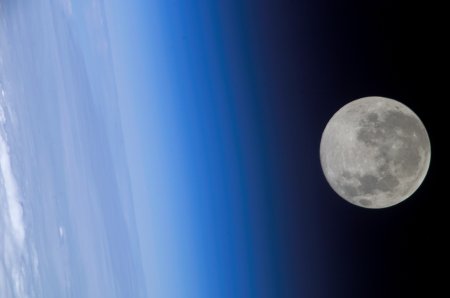
What these people don’t realise however is that the Space Shuttle Orbiters actually went nowhere near The Moon. In fact they barely escaped Earth’s atmosphere! The clue is in the name. An “Orbiter” does just that, it orbits Earth.

Here’s a scale-model analogy that will help to put this into perspective.

Imagine Earth is the size of a basketball and The Moon is the size of a tennis ball. This is a surprisingly accurate scale approximation since the diameter of The Moon is roughly 3.7 less than Earth.

Using the same scale, the basketball and tennis ball would need to be 7.5 metres apart to represent the distance between Earth and The Moon.

On the same scale how far away from Earth (basketball) do you think the Space Shuttle travelled on its voyages to the International Space Station?

The answer is just 0.8cm.

Yes, less than a centimetre. This is correct I assure you!

The distance between Earth and The Moon is roughly a thousand times further away than Earth and the ISS.

So how useful was the Space Shuttle in furthering space exploration for mankind?