Securing Dropbox

After the well publicised Dropbox security failings, I started searching for a solution which would allow me to encrypt private data held in my Dropbox while still having easy access to it from my personal Mac.

I could create a Mac encrypted disk image but this would be unwieldy to manage and probably result in large file updates whenever any of the contents were changed.

A more elegant technical solution is to create an encrypted user-space filesystem. It’s a bit more work to setup and you will need a combination of tools, but it does allow for a much more flexible and manageable configuration.

Instructions:

/usr/bin/ruby -e "$(curl -fsSL https://raw.github.com/gist/323731)"
  • Install Apple Xcode – this can be downloaded from the Apple Developer site
  • Install the latest EncFS encrypted filesystem (v1.7.4 at time of writing):
sudo brew install encfs

I want to make this installation as secure as possible so I’m not going to store the EncFS key file on Dropbox. To accomplish this I use a neat trick.

We’re going to create a new encrypted volume, but do this locally first so the EncFS key is never synchronised with Dropbox:

encfs ~/Desktop/Secure ~/Documents/DropSec

Answer ‘yes’ when prompted to create the new folders and choose ‘p’ for pre-configured paranoia mode (256-bit AES encryption). Enter a secure password when prompted and you’re done.

Now the filesystem has been created we can deal with the key.

umount ~/Documents/DropSec
mkdir ~/.encfskeys
mv ~/Desktop/Secure/.encfs6.xml ~/.encfskeys/dropsec.xml

Remove the /usr/local/bin/encfs symbolic link …

rm /usr/local/bin/encfs

… and replace with a simple wrapper script.

Use a text editor to create the following script:

#!/bin/sh
# Wrapper to EncFS
REALENCFS="/usr/local/Cellar/encfs/1.7.4/bin/encfs"
MYUSER=`whoami`
export ENCFS6_CONFIG="/Users/${MYUSER}/.encfskeys/dropsec.xml"
$REALENCFS "$@"

Don’t forget to make the new wrapper script executable:

chmod 555 /usr/local/bin/encfs

Create a dummy key to ensure that the Macfusion plugin will recognise the EncFS volume:

touch ~/Desktop/Secure/.encfs6.xml

Now move the entire ~/Desktop/Secure folder into your Dropbox:

mv ~/Desktop/Secure ~/Dropbox/

To check the secure volume settings use:

ENCFS6_CONFIG="/Users/youruser/.encfskeys/dropsec.xml" encfsctl info ~/Dropbox/Secure

To change your secret password use:

ENCFS6_CONFIG="/Users/youruser/.encfskeys/dropsec.xml" encfsctl passwd ~/Dropbox/Secure

Use the Macfusion GUI to mount and unmount the volume when you need it.
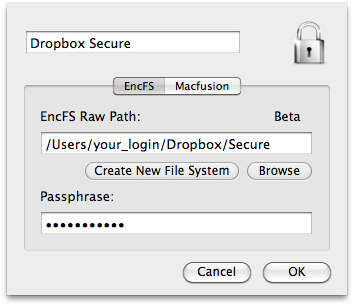
  • The EncFS Raw Path is /Users/youruser/Dropbox/Secure
  • The Passphrase is the password you gave when you created your EncFS volume
  • The Mount Point is the local (unencrypted) folder where you access your secure folder (in this example we have used /Users/youruser/Documents/DropSec)

You should now have an encrypted volume in your Dropbox which you access via your local ~/Documents/DropSec mount.

The security of the ~/.encfskeys/dropsec.xml key file is of paramount importance. This is the EncFS decryption key which must stay in that folder. If you delete this file then all your encrypted data is gone forever, so keep a secure backup somewhere else just in case.

UPDATE: Read this post for a new method of creating a secure Dropbox folder.

Sponsor Me!

I have an unwritten rule with friends and colleagues – don’t ask me to sponsor you and I won’t ask you to sponsor me. Generally this works well, but as some people have not got the message I’ll spell it out.

I’m glad that you feel so passionately about a cause that you are prepared to dedicate your time and energy to it, but please don’t think badly of me because I don’t. I have my own list of charities that I support and I don’t force them on you.

Don’t try and convince us that you have no personal interest in climbing Mount Kilimanjaro, swimming the English Channel or running the London Marathon. It’s almost certainly not an altruistic endeavour. You probably would have done it without any sponsorship, in fact in some cases committing to a minimal level of sponsorship was a necessary evil to enable you to participate.

To sum up, if you want me to subsidise little Johnny’s playgroup then just be honest and say that. Don’t try and dress it up as a grand athletic event so impressive that I will feel compelled to shower the participants with cash to show my appreciation.

Customer Data Insecurity

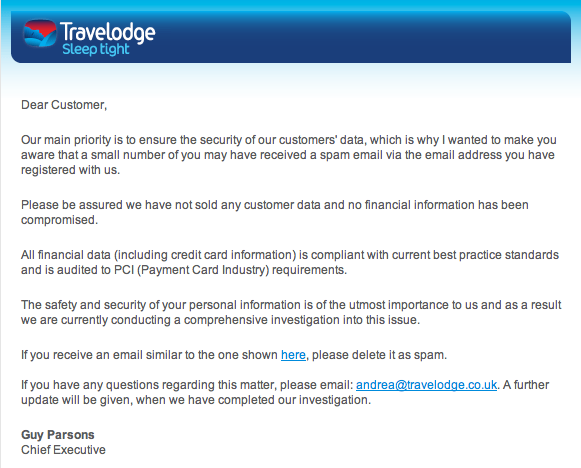
In the last couple of weeks I’ve received separate emails from Sega and Travelodge informing me that my personal details have been ‘stolen’ by hackers and may be used in phishing attacks against me. These are just a couple in a long line of examples of well publicised hacks against major online sites.

Actually this likely won’t affect me at all. I have no faith in web sites keeping my personal data safe and don’t trust the security of online retailers at all. My email is delivered via collaborative filtering anti-spam techniques and I rarely see spam nowadays anyway.

I use a different secure password for every web site and never divulge real personal details in online registrations. They don’t have my real date of birth, mother’s maiden name or anything else considered valuable information by the hacker community.

Don’t forget that the retailers have no idea what your real personal details are, so you are perfectly entitled to make up what you want when you register with them. I strongly advise you to invent a pseudo-identity with an alternative date of birth and security credentials. As long as you keep note of what these are then you won’t have a problem with authentication and you won’t be exposed to serious data theft if your details are exposed.

It’s disappointing, but not surprising, that online retailers are being compromised in this way. Despite Travelodge’s claims that their “main priority is to ensure the security of our customers’ data” I don’t imagine that customer data security is at the top of the average retailer’s requirements list when it comes to web site design.

As Travelodge are so fond of saying – “Sleep tight” !

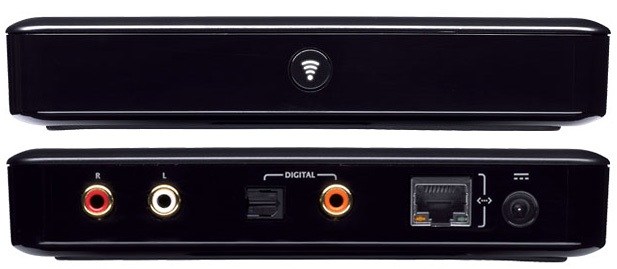
Squeezebox Receiver without a controller

It is indeed possible to setup a standalone Logitech Squeezebox (Duet) media receiver without needing to fork out for the controller. To be frank there are much better (and cheaper) controller software solutions out there for iOS and Android, but an extra Squeezebox receiver can be very handy.

The Squeezebox receiver can currently be picked up for just shy of £80 from Superfi – inclusive of VAT and delivery!

Once you’ve got your receiver you’ll need to configure it with an IP address and server information. Usually this would be done via the controller, but thanks to Robin Bowes you can use his Net::UDAP Perl module to do it all from a PC or Mac.

As long as you’re comfortable using the command line and Perl, you will find the udap_shell.pl script very simple to use and be up and running within minutes.

MacBook keyboard not working?

A couple of times now I’ve found that the keyboard on my MacBook has stopped responding.

This wasn’t a hardware failure, it turned out it was due to ‘Mouse Keys’ being enabled.

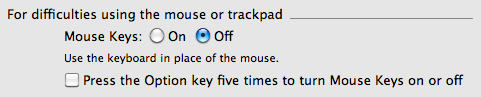
Mouse Keys is a setting which allows you to control the mouse with the keyboard. It is accidentally enabled by pressing the Option (alt) key five times in a row.

To switch it off again press the Option (alt) key five times.

To disable it permanently go to the Universal Access preferences and un-tick ‘Press the Option key five times to turn Mouse Keys on or off‘.

System Preferences > Universal Access > Mouse & Trackpad

For more details on Mouse Keys see this Apple Support article – Unable to type while Mouse Keys is enabled in Mac OS X