Tips for cyclists

Wearing team colours won’t help you ride like Lance Armstrong, any more than putting on a Man United shirt helps you score goals like Wayne Rooney.

It doesn’t matter who you are or what shape you are in – Lycra is not flattering.

Try lifting your head and sniffing the air instead of the bum crack of the cyclist in front.

Having a cycle that weighs less than a bag of sugar won’t help you win le Tour de France.

Fitting a bell will not interfere with the delicate balance of your cycle.

Pavements are meant for pedestrians.

The UK road network is designed for motor vehicles. If you’re going to use it, abide by the rules.

You know those mysterious boxes with red, amber & green lights? Those are traffic lights. Yes, they apply to you too.

Ride in single file on narrow or busy roads and when riding round bends – like the Highway Code instructs you to.

It’s not embarrassing to be seen using cycle lanes instead of busy roads, so for everyone’s sake make use of these when they are available.

Public urination is just that. Calling it a “nature break” doesn’t make it any less disgusting and unsanitary.

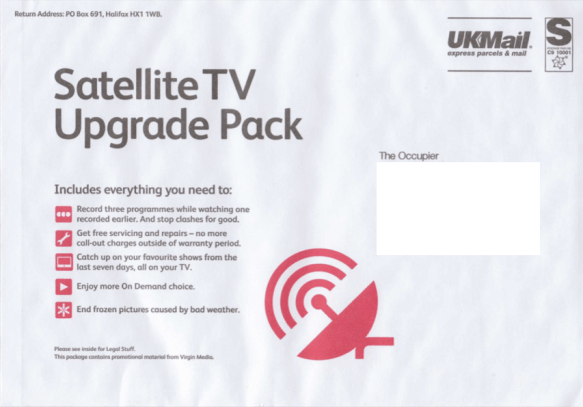
Satellite TV Upgrade Pack?

The image above is of a jiffy bag that I received in the post this morning.

Being the wary soul that I am, I was immediately suspicious of this package and so inspected it in more detail.

On face value it looks like an official upgrade pack, perhaps from the satellite broadcaster BSkyB? They do occasionally update their viewing cards and so this seemed quite likely.

But on closer inspection I spotted this small-print:

This package contains promotional material from Virgin Media.

I should have guessed as much when I saw that it was addressed to “The Occupier”. This is a well known tactic of Virgin Media to stop their tat being classed as addressed mail and thereby sidestepping the Mailing Preference Service. I’ve never been able to shake off Virgin’s junk mail, I don’t think anyone ever has.

So this package isn’t anything to do with satellite TV at all. It’s yet more pointless unsolicited junk mail from Virgin Media.

A quick bit of web searching and I found a recent Advertising Standards Authority (ASA) Adjudication on Virgin Media Limited.

The conclusion of the adjudication was that Virgin Media had breached two Committee of Advertising Practice codes and that their advert was misleading.

The ASA noted the text “This package contains promotional material from Virgin Media” was considerably smaller than the main copy on the front of the envelope, was at 90 degrees to all the other text on the envelope, and was located far to the right of the envelope under a series of reference numbers.  We considered that the combination of those factors meant it was likely to be overlooked by consumers and that consumers would therefore be unaware that the envelope contained promotional material from Virgin.

We noted Virgin considered the text “Please see inside for Legal Stuff” indicated that the envelope contained promotional material.  However, we considered that that statement was unlikely to be understood by consumers to mean that the mailing was a marketing communication. We considered, for instance, that the placement of that statement, combined with the likelihood that consumers might not have noticed the text which identified that the mailing was from Virgin, could lead consumers to think that the envelope contained legal and other information, and possibly technology, from their satellite TV provider which would result in an upgrade to their existing satellite TV package.

We considered the ad did not make clear that it was a marketing communication, or that it was sent with commercial intent, and concluded that it breached the Code.

The ASA adjudication is dated 2nd November 2011, but I received this package today on 16th November 2011.

It looks like Virgin have subtly altered the layout on the envelope and moved the line about it being promotional material, but this doesn’t make it any less misleading.

A complaint to the ASA has been submitted. Let’s see what happens this time!

Update!

The ASA response:

Further to my letter of 21 December, we have now received a response from Virgin Media. They have assured us they will not use the ad or similar ads again and that in future mailings they will make clear that they are marketing communications. We consider that this will resolve the complaint without referring the matter to the ASA Council, and will consequently be closing our file.

In a formal investigation, if the ASA Council decides that an ad is in breach of the Code, the advertisers are told to withdraw or amend it. Because Virgin Media has already assured us that the advertising you complained about has been withdrawn, we consider there is little to be gained from continuing with a formal investigation, which would achieve the same outcome.

So a small victory for the small guy then.

Opting-out of Google Location Server

In September Google announced their intention to comply with requests from European data protection authorities and offer a method for opting-out of their Google Location Server (GLS).

Peter Fleischer (Google’s Global Privacy Counsel) has today published an update on the European Public Policy Blog and Google have added specific opt-out details on their Maps Help page.

What is GLS? It’s a location service that most Android smart phones use to request your current location. Your smart phone could simply use satellite positioning (GPS) to accurately pin-point your location, but GPS consumes battery and generally only works outside.

Instead of using GPS your smart phone attempts to discover your location by scanning for nearby WiFi access points. It gathers the relative signal strengths, network names and unique network addresses and sends the details to the Google Location Server (GLS) for processing.

The GLS checks its database of WiFi access points and returns an estimate of your location. If your local WiFi access points are known and already in the GLS then it will return a fairly accurate location, almost on a par with GPS, for a fraction of the power.

Google built their WiFi location database while collecting data for Google StreetView and it is constantly updated and augmented by smart phone crowdsourcing. The manner in which Google collected this data has been controversial and Google have been investigated for breaches of interception laws. As a result Google has been forced to offer this opt-out scheme to appease regulators.

So what do you need to do to ensure that your own WiFi access point is not included in the Google Location Server database?

Simply append “_nomap” to the SSID of your WiFi network and Google will remove it from their database the next time a device sends information to the GLS.

It’s undoubtedly an inconvenience to change your WiFi network name and re-associate all your wireless devices, but if this scheme is adopted by all the mapping services (Microsoft, Apple, Skyhook) then it could well be worth it.

Android shortcuts

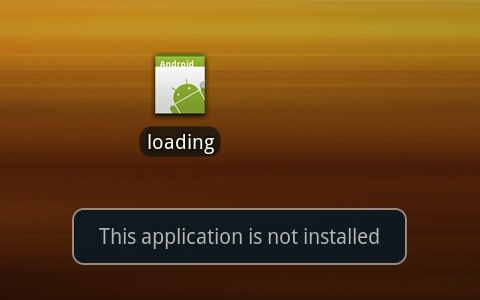
I’m frequently being offered app updates via Android Market. Most of these work without a hitch, but occasionally I update an app and then find that it no longer runs from an existing shortcut. The device reports “Application is not installed on your phone“, or the shortcut icon has disappeared altogether.

The problem stems from the way in which Android creates shortcuts. An Android shortcut is not simply an alias to the application binary, it’s actually an Intent that directly specifies the ComponentName it should run.

It’s not enough to use the same manifest package name and digital certificate when you publish an update to your app.

For any existing shortcuts to carry on working you also need to ensure that the ComponentName is identical, which means making the entry point Intent the same as it was in the previous version.

In short, keep your ACTION_MAIN Intent the same and your app will update cleanly.

Adobe retires Flash for mobiles

In early 2010 Apple announced the eagerly anticipated iPad and iPhone 4. They were hugely successful product launches, but at the same time Apple also came under increasing pressure from customers and developers to support Adobe Flash on their shiny new iOS devices.

In reaction to the criticism Steve Jobs delivered a scathing personal attack on Adobe Flash in an Apple article entitled “Thoughts on Flash“.

Jobs began by saying he “wanted to jot down some of our thoughts on Adobe’s Flash products so that customers and critics may better understand why we do not allow Flash on iPhones, iPods and iPads“.

In his critique Jobs went on to detail six main reasons why Apple was so staunchly against Flash, which I have paraphrased below:

  1. Open. Adobe’s Flash products are 100% proprietary. By almost any definition, Flash is a closed system.
  2. Full web. Adobe has repeatedly said that Apple mobile devices cannot access “the full web” because 75% of video on the web is in Flash. What they don’t say is that almost all this video is also available in a more modern format, H.264, and viewable on iPhones, iPods and iPads.
  3. Reliability, security and performance. Symantec recently highlighted Flash for having one of the worst security records in 2009. We also know first hand that Flash is the number one reason Macs crash.
  4. Battery life. H.264 can be decoded in hardware which doubles battery life during video playback.
  5. Touch. Flash was designed for PCs using mice, not for touch screens using fingers.
  6. Cross platform. We know from painful experience that letting a third party layer of software come between the platform and the developer ultimately results in sub-standard apps and hinders the enhancement and progress of the platform.

Reading Jobs’ article again really highlights his genius for strategic vision.

New open standards created in the mobile era, such as HTML5, will win on mobile devices (and PCs too). Perhaps Adobe should focus more on creating great HTML5 tools for the future, and less on criticizing Apple for leaving the past behind.

Steve Jobs
April, 2010

How prophetic that closing paragraph was in light of Adobe’s announcement just 18 months later to cease development of Flash for mobile devices, and focus on HTML5 instead.

The news of this dramatic Adobe turnaround came in an official blog post from Danny Winokur, VP & General Manager, Interactive Development at Adobe.

Flash to Focus on PC Browsing and Mobile Apps; Adobe to More Aggressively Contribute to HTML5

HTML5 is now universally supported on major mobile devices, in some cases exclusively.  This makes HTML5 the best solution for creating and deploying content in the browser across mobile platforms. We are excited about this, and will continue our work with key players in the HTML community, including Google, Apple, Microsoft and RIM, to drive HTML5 innovation they can use to advance their mobile browsers.

Our future work with Flash on mobile devices will be focused on enabling Flash developers to package native apps with Adobe AIR for all the major app stores.  We will no longer continue to develop Flash Player in the browser to work with new mobile device configurations (chipset, browser, OS version, etc.) following the upcoming release of Flash Player 11.1 for Android and BlackBerry PlayBook.

Although Jobs was undoubtedly correct to back the HTML5 open standard, I have to question whether he was merely a soothsayer or the architect of Flash’s demise. Clearly with no Flash support on Apple’s iOS products there was a massive disincentive for developers to continue using Adobe’s technology.

Either way, Jobs got his way. It’s a shame he never got to see it.