Hotmail account recovery

I’m trying to resurrect an old hotmail.com address to use it as a Windows Live ID.

Admittedly the last time I used the address was a few years ago, but it is still mine and I should be able to get it back right?

The first obvious problem I encounter is that I’ve forgotten the password. I try the ‘Reset your password‘ link and gave the secret answer to my security question.

Windows Live responds with: “This option is temporarily unavailable because incorrect information was entered too many times. Please try another option or try again later.”

So far so bad.

I go for the ‘Customer Support’ option instead and attempt to fill out an account recovery form.
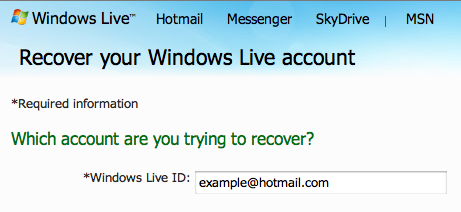
“Help us to make sure that this is you. To recover your account, enter as much information as you can.”

I have a go at providing old passwords, possible subject lines for old emails and contacts I’ve previously sent email to. I last used the account in 2008 so my memory is more than a bit hazy.

After a few hours I received this email response from Microsoft:

Unfortunately, we could not verify your ownership of example@hotmail.com using the information you provided. Your account recovery request with issue number 12345678 has been closed.

In keeping with Microsoft’s commitment to protecting online privacy, Windows Live takes account security seriously. Passing the account recovery process can be difficult. Please reconsider your originally submitted information, as well as provide any additional information when submitting a new account recovery request.

Here are some suggestions to assist you in submitting a new request:

  • Answer questions using the information you used when you created the account or last updated it.
  • Submit the recovery request from a computer you frequently use for Windows Live services.
  • Answer as many questions as you can and be as precise as possible.
  • For questions with multiple answers, such as email subjects and contacts, provide as many answers as you can.
  • If you have difficulty remembering email subjects or contacts, try reaching out to family, friends, or business contacts to verify.

Ready? Click here to submit a new Windows Live account recovery request.

Please do not reply to this message. Replies to this message are routed to an unmonitored mailbox.

Thank you,
Windows Live

Not a great help. I’ve tried a couple more times, but I get the same response each time.

Does anyone have any suggestions, or have I lost my account forever?
BlackBerry Fool

This post could perhaps have been more aptly titled ‘BlackBerry Jam’, but actually I don’t want to focus on the widespread service failures so much as the foolish customers who chose to rely on BlackBerry in the first place.

Why is it only now they realise that what they bought into wasn’t the Internet in your pocket, but a totally proprietary email and messaging service with an inherent single point of failure?

For the uninitiated, BlackBerry is a mobile email, messaging and web browsing service provided by Research In Motion Limited (RIM). The difference with BlackBerry services is that you don’t have a direct connection to the Internet like everyone else, instead all your mobile data traffic is tunnelled through RIM’s data centre(s).

The advertised advantage of this approach is that RIM applies data compression techniques to make more efficient use of the available bandwidth, which should result in faster web browsing and quicker email delivery.

For the privilege of using their data optimisation service RIM levies a hefty monthly System Access Fee (or SAF). This hidden per-subscriber BlackBerry tax is usually collected by the mobile operators in the form of higher monthly subscriptions or call charges.

The SAF revenue stream is hugely lucrative for RIM, which is why they are so keen to keep customers tied into their proprietary service model.

But RIM’s unique selling point is also their biggest flaw.

The problem with their architecture is that you are putting all your metaphorical eggs in RIM’s one basket. As we’ve seen with the prolonged service outages over the last two days, if RIM’s servers go down then so does all your connectivity.

RIM have been surprisingly tight-lipped about the problems. There is nothing on their corporate web site, nothing in the press releases. It’s like we imagined the whole thing!

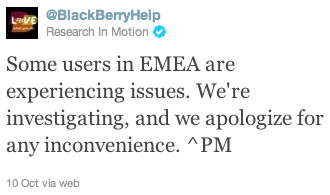
The only source of information I’ve found is RIM’s official Twitter support account.

The news was broken yesterday with:

Some users in EMEA are experiencing issues. We’re investigating, and we apologize for any inconvenience.

This was followed up by:

We apologize to any of our customers in Europe, Middle East & Africa still experiencing issues. We’ll bring you an update as soon as we can.

BlackBerry email services restored. Some users still experiencing delays with browsing and IM. Sorry for inconvenience.

Just when we thought everything was getting better, more problems this afternoon:

Some areas have messaging delays and impaired browsing. We’re working to restore normal service as quickly as possible.

The most recent RIM Tweet says:

Message delays were caused by a core switch failure in RIM’s infrastructure. Now being resolved. Sorry for inconvenience.

Lots of faceless apologies from RIM, which is of little consolation to their customers.

This issue reminds me of my blog post about the Proprietary Internet. The success of the Internet has been that its distributed architecture makes it resilient from individual system failures. It was deliberately designed this way.

If you tie yourself into a single service provider then don’t be surprised if one day you too find yourself cut adrift from the connected world. If this communication tool is so critical to your business then it’s your duty to ensure that you have exercised due diligence in your choice of service provider.

You’ve only got yourselves to blame!

Front Page News?

It’s bewildering what the BBC considers to be front page news.

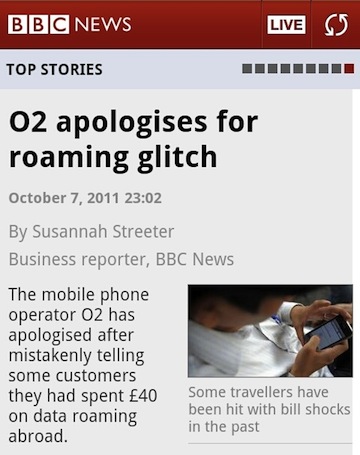
BBC NEWS TOP STORIES: O2 apologises for roaming glitch

Oh dear! Did international roaming fail leaving O2 customers without data services abroad, or did naughty O2 overcharge their customers? No, neither.

This headline actually relates to an insignificant story of how a very small number of O2’s roaming customers received a text message incorrectly informing them that they had run up large data roaming charges.

Rachel Sinclair, from Bristol, was just hours into her trip to France on the 24 September, when she received a text on her iPhone telling her she had downloaded £20 of data.

“I double checked the roaming function was off and then turned off the handset but the next morning I received another text saying the bill had gone up to £40. I was away with friends and it really took a bit of pleasure out of the holiday.”

After investigating her case, O2 said that she had in fact accrued just 60p in data roaming charges, not £40.

The company estimates that she was one of up to 100 customers who were sent messages in error at the end of last month, warning them they had reached data roaming limits even though they had not downloaded that amount.

So this wasn’t a case of a mobile operator overcharging, just their automatic warning systems being a bit trigger happy.

This text glitch apparently affected “up to 100” of O2’s 22 million mobile customers (0.0005% of O2’s mobile customer base), but still the BBC News editors deemed this story of sufficient international public interest to promote it to their front page.

BBC: Some travellers have been hit with bill shocks in the past

So? Some travellers have been hit by lightning in the past! What has this got to do with anything? It’s sloppy sensationalist journalism, at a time when the National Union of Journalists are complaining about the proposed cuts at the BBC. First for the chop should be Susannah Streeter, the author of this drivel.

Steve Jobs

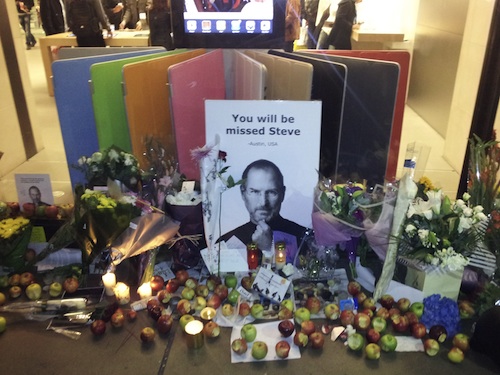
I am feeling quite emotional about the sad passing of Steve Jobs. I have previously been closely involved in the technical development of iPhone and so perhaps feel a more personal connection that extends beyond being an Apple fanboi.

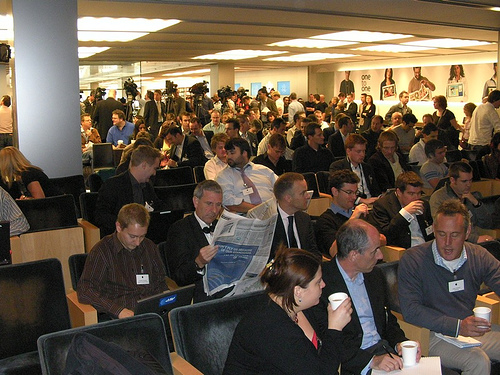
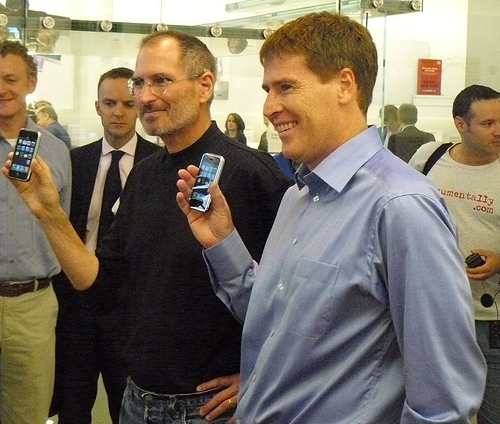
The closest I came to meeting the great man in person was at the ‘Mum is no longer the word‘ Apple press conference at the Regent Street store in London on 18th September 2007. I’m lurking in the crowd somewhere in the auditorium below!

I’ll never forget the buzz of anticipation from the assembled hacks as Steve Jobs took to the stage to announce the exclusive partnership between Apple and O2 (to sell the original iPhone). This was the worst kept secret in the industry, but the excitement of Jobs coming to town to personally reveal the deal was palpable.

I read the news of Jobs’ death this morning while checking the BBC News app on my touch-screen mobile phone. This is the type of information snacking that most smart phone users do habitually and now take totally for granted.

The way we interact with mobile devices and consume mobile data has changed beyond all recognition since the original Apple iPhone launched in 2007.

Jobs’ obsessive attention to detail in all aspects of Apple’s product development has made complicated technology accessible to all. iPhones, iPods and iPads have become ubiquitous, not just because of their technical capabilities but because they are beautifully simple to use.

Jobs has left a lasting legacy of technological achievements, but his early death is also a reminder of the fragility of life.

The man had an almost limitless supply of cash and arguably the most technologically inventive minds in the world at his disposal, but he could not buy his health.

So long Steve – and thanks.